Human Tragedy
News: 7th Std kid shot dead by Army in Chennai when he entered their residential complex (To collect almonds)
Only a few days back I heard a few prominent Kashmirs’ discussing situation in Kashmir when one speaker touched the point of impunity with which security personnel operate in Kashmir and other troubled parts of India.
Killing innocent people for gallantry & monetary awards or just killing people because they are mere suspects and then they are not accounted for their actions.
Other crimes like abuse, rape, humiliation and demeaning behaviour are used as suppressive tools.
When these security personnel get used to such behaviour the chances of behaving them in similar way when they are moved to un-troubled parts are more.
This incident looks like part of same cycle.
PS:
I read this news article on of the Indian news channels website and comments posted by people about the incident were too shocking.
Majority of people there have no sympathy with the poor boy, they are blindly supporting army because they are protectors and fight enemy. Even some calling it a “trivial issue”
I don’t know what has blinded them and why can’t they see any human tragedy here.And may be same reason doesn’t let them feel the agony Kashmir’s are going through
Peace is an undervalued blessing

Many years ago, one afternoon in Kashmir an 18 year old was getting ready to hang out with his friends when he and his mother heard a loud noise. Having lived in Kashmir all their lives they immediately figured a grenade had exploded on the street in front of their house. The first reaction, like a reflex, is to lie flat on the floor so that if any shots are fired you would not become another number in the total casualties of the conflict. So the mother and the son did exactly that.
The mother told her son from another room not to go out. Whenever a grenade exploded in the streets of Kashmir it would be followed by shooting and result in more deaths. However, that day was different. There was complete silence on a usually busy street only to be broken by the painful shrieks of women. This teenager slowly raised his head to look out the window. He saw two women lying in the middle of the street crying for help with no one else in sight, as if everybody else vanished. He could see the helplessness of those women and feel the fear in their hearts, the fear of death.
If nobody helped them they would bleed to death, he thought. So he rushed down to the street to help them. As he reached near these women, he heard the sound of loading guns. He turned around and saw at least 20 guns pointed at him by the security forces who were outside the outlets. He also noticed lots of people huddled in those outlets, scared and surprised. Everything was clear now, the silence and the vanished people. The teenager realized that is it. This is the end of his life. He thought about his mom who still thought her son was in the next room. He thought of the rest of his family and his friends whom he was never going to see again. His life rolled in front of his eyes in those few seconds. His first reaction was neither to become a hero nor a martyr, so he raised his arms and started heading back toward his house. However, just before he would enter his house the thought of those women dying on the street came back. At this moment, he turned around and started running toward those two women while yelling for help. As he reached the women, he was joined by around 10 other people and a car came which took those women to the hospital. It was learned later that those two women survived.
The teenager rushed back to his home and when asked by his mom if he had gone out, he replied, “no, I was just closing the front door”. Unlike some other days that day was good because no lives were lost. Many years later peace still remains elusive in Kashmir and people continue to die young. If you are living in peace, cherish and value it. There are people in this world who never get to see it.
“Slumdog Soldiers”
I have been pondering how best to characterize the Indian occupation forces here. And then it dawned on me that calling them “Slumdog Soldiers” would best convey what Kashmiris truly feel about them. It is no secret what Kashmiris call the Indian soldiers and whisper to each other every time we see these criminals on our streets. But for benefit of keeping this blog free of name-calling and obscene terms, “Slumdog Soldiers” seems an appropriate term because it accurately portrays the irony that the occupation is.
The Kunan-Poshpora Tragedy: Two decades of Inaction
 “There was darkness all around. At 9:30 pm in the evening the army entered the village. They took the men and children out and they were taken to a nearby bus stand. Then they entered our homes at around 11:00 pm and started assaulting women.”

Draped in an embroidered pheran (a traditional Kashmiri gown) and a white scarf, a bespectacled elderly woman recalls the night of February 23, 1991. She is sitting in her home in Kunan-Poshpora, a small village in the north of Kashmir, the northernmost Indian state that has witnessed much violence and turmoil since 1947.
According to the old woman, around 10 to 15 soldiers entered every home in the village. “They would gag women to prevent them from raising hue and cry. We were not able to make much noise,” she says. There must have been around 1,000 soldiers in the village that night, she recalls. When interviewed in 1991, villagers claimed about 100 women had been molested. “They left the very small girls untouched,” she adds. “Besides them, no one was spared.”
The women were systematically assaulted and gang-raped, regardless of marital status, pregnancy, or age.
The next day at 10:00 am, the deputy commander of the soldiers came to the village. “He told the women that the army has not done anything wrong.”Furious, this elderly lady pulled her friend, who was also abused that night, out of her home to stand in front of the army commander. “I told him that she is an 80-year-old lady, but even she was not spared by his men.”
“He didn’t say a word. He stood speechless,” she recalls. “He just looked down.”
Seventeen years have passed since that night, but justice has yet to be achieved for the rape victims of Kunan-Poshpora. Up until now, nobody in the village has been willing to talk. Silence about that night, a collective gesture from the villagers, greets you like a wall. But behind this silence lie tragic stories.
On April 7, 1991, the New York Times reported the Kunan-Poshpora rape incident under the headline, “India Moves Against Kashmir Rebels.” According to the report, on March 5, 1991, villagers complained about the incident to the then-Kupwara District Magistrate, S.M Yasin, who visited the village two days later to investigate. “According to a report filed by Yasin,” the article reads, “the armed forces behaved like violent beasts.” He identified them as members of 4th Rajputana Rifles and said they rampaged through the village from 11:00 pm on Feb 23 until 9:00 am the next morning.
The Indian authorities have dismissed the mass-rape charges as “groundless.” No further investigations have been conducted. The Kunan-Poshpora rape case has been buried like thousands of other cases of rights abuse by men in uniform in Kashmir.
However, in its 1992 report on international human rights, the United States Department of State rejected the Indian government’s conclusion, saying there was “credible evidence to support charges that an elite army unit engaged in mass-rape…in Kunan-Poshpora.”
After initial reluctance and much prodding, Saifuddin, a village elder from Kunan-Poshpora, opens up. (Family names are not commonly attributed to people from Kashmir and were not collected for this story). His story is like that of the old woman. “It was snowing outside that night. People were sleeping in their homes. The army came and entered every home. The men were taken out and interrogated near the village bus stand.”
He pauses, briefly. “Then they locked the rooms and raped our mothers and sisters.”
As dawn broke on that night in 1991, the soldiers let the men of the village go. The men immediately ran for their homes. “When we reached our homes we found our womenfolk weeping,” says Saifuddin. Despite their rage, which prompted them to seek swift justice for the crimes of the soldiers, the people of the village were unable to do anything. “We would have gone to lodge a First Information Report (FIR) against the army, but we couldn’t as the entire village was cordoned off.”
Four days after the incident, the villagers eventually were finally able to gain an audience with the nearby authorities. They collectively lodged an FIR at the nearby rural police station. The police arrived in the village to collect evidence and file a case against the army.
It was not difficult to muster up evidence and credible witnesses: doctors and nurses examined the women, police confirmed mass rape, and a report was submitted. But according to the villagers, almost 20 years later, the reports of doctors confirming rape are still lying in the Trehgam police station near Kunan-Poshpora. Dilbar Singh, who was the Deputy Superintendent of Police of Kupwara in 1991, investigated the case, but after he was promoted the investigation was stopped.
The incident has had serious ramifications for the women in Kunan-Poshpora that extends far beyond psychological damage and sensitivity. Memories of the incident are raw. Some women are even now afraid of marriage, while others are harassed or ignored by the men of the village because of the stigma associated with rape.
A young woman named Rahte was holding her baby in her lap when the men entered her home. “She fell from my arms near the window as I shouted for help.” Rahte’s daughter – who was a baby in 1991 on that night – comes inside the room, limping from the injury on her left leg that she sustained that night. More than thinking about her own past, her mother is worried about her daughter’s future. Her daughter hides behind Rahte’s scarf, shying away from any talk about her. “She doesn’t want to marry now,” Rahte describes as her daughter keep her eyes lowered, fiddling with the edges of her mother’s scarf.
Over the years, many Kunan-Poshpora families have opted to marry their daughters to relatives because it is now difficult to find suitable matches in other villages. “People outside the village talk about our daughters, and say they are from ‘that’ village,” she says, putting emphasis on the word so that it becomes derogatory. “This label has made our lives difficult.”After the incident, some women who were unable to live with the shame fell into depression and died in the years that followed. Many refuse to talk about the abuse they have subsequently suffered from their neighbours and others.
Sakeena’s life has taken a turn for the worse since 1991. Her eyes are cold and expressionless as she explains that her mother was 35 years old when the men barged inside their home. Sakeena herself, being but a girl at the time, was not hurt, but she was in the house while her mother was raped.
Sakeena was married outside her village in Nowgam six years ago, but at the time of her wedding, her in-laws were unaware of her village’s sad history. When they eventually learned about the incident from newspapers and relatives, life became difficult for Sakeena.
“She was harassed and taunted by her in-laws,” her mother tells us in her modest house overlooking a narrow street. Three years ago, Sakeena was sent back to her home in Kunan-Poshpora. Her in-laws are now seeking a divorce, but instead of talking to Sakeena directly, they delivered the message to her neighbors. The shame they seek to impart on her is manifest. Her husband never came to take her back and she had a stillborn child.
Another woman from Kunan-Poshpora, Sameena, who lives down a small street from Sakeena, has a very different story to share. She was married only a few days before the incident occurred in 1991. The morning after she and other village women were assaulted, the soldiers slung a gun across her shoulders. “They took pictures of me while I was paraded before the villagers,” she recounts. The soldiers used these tactics to instill fear in the villagers.
But unlike other victims, Sameena refuses to simply live with the shame. She wants a life of dignity, not the condemned life of victim. She also wants to help other victims. A social worker in the area came up with the idea of establishing a self-help group, and Sameena jumped at the opportunity to be involved.
Sameena was instrumental in bringing together 15 local women to form the self-help group, of which she is now the Chairwoman. Three years ago, and with some financial help from the social worker, she opened a bank account for the 15 Kunan-Poshpora rape victims. Initially three lakh rupees, or about $6,670.00 USD, were deposited in the account. Now, the women save some money each month. They are truly an anomaly in the village.
The men of Kunan-Poshpora have had difficulty dealing with the reality and aftermath of the incident. Some have resorted to violent revenge. After the mass rape, approximately 35 unmarried young men, between the ages of 18 and 30, left their homes to cross the border into Pakistan for arms training. They wanted revenge. According to the villagers, about 20 out of those 35 boys have been killed by now, and more have disappeared.
A woman from the village says her only son left home immediately after the incident. “He couldn’t see us in this condition. He was 18 when he left home. I came to know later that he had crossed the border for arms training,” she says as tears well up in her sunken eyes. She says her son returned after some years, to seek revenge and redemption for the women abused during the incident. “He was later killed by the army in an encounter.”
The village elders say being interviewed by journalists, human rights activists, and filmmakers from across the world has brought only disrepute to the village and its women instead of redemption. The rape victims, having recorded their statements on multiple occasions in the years following February 23, 1991, feel ostracized and ignored by the government. No financial compensation has been provided to the affected women. Kunan-Poshpora has had to rebuild itself.
At another home in the village, a bearded jobless young man says he gets very angry when journalists and human rights activists ask his mother questions about that night.
“Many people from India and abroad have come to this village in the past years,” he says angrily. “They record the testimonies of our mothers and sisters, and then they never return.”
Frustrated, angry, and impotent; bitterness lingers in Kunan-Poshpora, and the injustice of 20 years ago remains.
(Majid Maqbool is a Kashmiri journalist. This article appeared in Dispatches International (DI), a feature magazine produced by student journalists from around the world in 2010.)
Justice for Kashmir
BY:BRINDA KARAT
“Hamara khoon, hamare bacche, hamari zindagi sab saste hain” (our blood, our children, our lives have all become cheap)—as mothers, wives, sisters and as citizens, women in the Kashmir valley expressed their anger, their protest and their sorrow thus, at a three day meeting in Srinagar organised by the central government’s interlocutors in Srinagar. The formal conference held on March 12-13 at the welcome initiative of Radha Kumar, member of the interlocutor’s team was attended by women from all the three regions, Jammu, the Valley and Ladakh. The purpose was to hear the experience and perspective of women and the solutions they offered as part of the discussion being held by the interlocutors with different sections of the people of the state. I attended as part of a group of four women MPs.
POURING OUT THEIR GRIEF
On the previous day, on March 11, a meeting was organised with the families of those who had been killed in the firings in the summer of 2010. As is known 117 young people, some of them children many of them teenagers, had been shot dead while hundreds more had been injured in the brutal actions of the security forces – whether by the JK police or the central forces. About 50 persons from the affected families attended the meeting and spoke of the circumstances in which their children were killed. The details were horrifying and showed the total lack of sensitivity on behalf of the central and the state government to deal with the mass protests by unarmed teenagers, indeed many of the actions by the security forces were criminal. Instead of dealing with the issues giving rise to spontaneous street anger, the state and the central government used repressive measures, including the use of draconian legal provisions to imprison young people, among them minors.
The speakers at the meeting poured out their grief, some with tears, some with anger, some expressionless as though the burden of their sorrow consumed all their energy, except to just survive. Among them:
“Ishrat and her three sisters from Badgam: My mother Rafika was killed by a bullet which flew through our window—she died before our eyes, we could do nothing to save her.
Rehana from Baramulla: Our child Asif, just ten years old was studying in Class 5. What was his crime? Was he carrying an AK-47? But he was shot by CRPF, we were not allowed to take him to hospital, he died without help.
Faiyaz Ahmed: My wife was too ill to come here. We lost our child Sameer, eight years old. He had taken two rupees from me to buy a toffee. While crossing the road he was brutally beaten and died.
Sister of Fancy Jaan: Fancy Jaan, 26 year old young woman, her beautiful photograph shown by her sister was shot dead in her own home in Batmalu, Srinagar when she went to the window of her home to draw the curtains.
Md Khan: My nephew, Muzaffar Ahmed Butt, just 17 years old, playing cricket with his friends, they hit him on the head with rifles and then hid his body.
Jahanara, mother of Aamir Kabir, a young man sitting by her side, blinded in both eyes by a deliberately aimed shower of pellets shot by the police when he had gone to get medicine for his ailing father. “He is a Class 12 very bright student. If they had killed him I would have suffered once. Now seeing his pain I suffer every minute, every second.”
FESTERING WOUNDS
There were many more such stories, including those of injured persons. These stories and others related by the families found resonance in the conference the next day. The voices of women from different sections of society, including some government officers, reflected the same feelings: Could this have happened in any other part of the country, and not even a constable been punished? This was the question asked repeatedly by the women.
A year after the terrible and tragic events, the wounds inflicted by a callous government fester precisely because not a single person in the police, the paramilitary forces or the administration has been punished or held accountable in any way. After strong protests, the state government had set up an inquiry committee that has only bought time, but has not taken any action. The families have tried to file FIRs against the killings of their children, in an effort to legally record the circumstances of their deaths. However, it is reported that out of 117 cases (some put the figure at 112), only 39 FIRs have been filed. It is for this reason that the demand for an impartial time-bound inquiry as well as immediate action in cases where there is prima facie evidence against specific personnel has been made by the CPI(M) and many others. However, far from accepting this demand, the government is reportedly threatening as well as arresting young people. In some police stations, photographs of the young men participating in demonstrations last year are routinely used to pick up the boys and insist on their frequent attendance in the thanas. This is leading to further resentment and anger. Even today, there are still many young “stone-pelters” languishing in the jails. As is known, minors had been arrested and locked up in jails even though this is totally illegal. Apparently the government answer was that Kashmir does not have juvenile homes, as though this could be an explanation to lock up children. Yet, release of the young people was one of the points of the so-called 8 point package agreed to by the central and state governments to address some of the grievances, a package which remains unimplemented.
Yet another issue is that of totally inadequate compensation or help to those injured and disabled. The families did not mention the issue of compensation even once; they believe that justice is more important, yet the evidence of the callousness of the government was apparent. Even where the breadwinner was killed, there is no job compensation offered. It seems that the present compensation rules admit compassion ground for job only when the person is killed by militants. But even in cases where innocents have been killed by the security forces, no job compensation is offered. Shockingly, young men applying for employment have to get specific NOCs from the police. Where jobs are scarce, this condition becomes another instrument to threaten and blackmail young people.
EFFECT ON WOMEN
Among the issues discussed in the conference was how the specific situation in the state of Jammu and Kashmir, termed a “conflict zone” by the organisers, affected women. A common experience was that of being victimised by violence, threats of violence, including of a sexual nature, the fear for the children and young people in the family, the constant insecurity and tension, the curbs on freedom of movement etc.
The presence of bunkers and uniformed personnel in residential areas, outside schools and colleges is a constant worry. The militarisation of the city and reportedly the entire valley is deeply disturbing, particularly for young women who feel threatened by the constant presence of armed forces, and indeed are often abused by their language and their gaze. Working women find it increasingly difficult to freely move around the city, constantly being checked by the security forces. Many women related the humiliation they felt when asked to show their identities by the security forces. Young women students, women college lecturers asked: “Is this not our state, our college, our home—why should we constantly have to prove our identities?” The reported cases of rape or sexual assault by the security forces have according to official sources led to punishment of those guilty. But if indeed this is the case, no one knows about it – it seems these are considered “internal matters.” This must be considered totally unacceptable in any democratic society. Security forces can have no such privileges of “identity protection”; on the contrary any such criminal act must invite swift and immediate punishment. But in the valley it seems that such action must be kept a closely guarded secret to maintain the “morale” of the forces. It is hardly surprising that no credibility is attached to such claims of action against those guilty. This is a shameful record and strengthens the feeling that the security forces act as an occupying power.
A disturbing development reported has been the impact in terms of the exponential rise in cases of depression among women, particularly middle aged and senior citizens. At the same time, the participation of women, particularly young women, in struggles for justice and democracy has hugely increased as has their resilience and courage. Unfortunately, the absence of working class women in the conference prevented a fuller understanding of how the conflict has affected them and their lives. The economic impact of the conflict was almost totally absent from the deliberations of the conference and was not included as a theme.
The discussions provided an opportunity for women from Jammu to express their views. Many of those who attended had in fact been born and brought up in the Valley but were driven out by militants and extremists in the early nineties. The sufferings these displaced Kashmiri families have faced – the loss of homes, identities, their culture, their friends, their livelihood – found eloquent expression from the displaced women. Almost two decades of displacement has had its own impact. The resultant resentment and frustration found expression in heated discussions and arguments. The representatives from Ladakh wanted their own defined area to be declared a Union Territory. Although the experiences are diverse and the aspirations equally diverse, there was at the end a convergence on the strong condemnation of the atrocities and human and democratic rights violations which had taken place in the valley, particularly in the last year. There was a near unanimous feeling that peace and calm cannot be sustained without justice.
Several practical suggestions were made by the participants. As a first official attempt to include women’s experiences in the dialogue process, the conference organised by the interlocutors was warmly welcomed by the participants.
However, such initiatives, though well intentioned and helpful, cannot substitute for political action and initiatives from the government of India to address the problems in Jammu and Kashmir. It would seem that even as the wounds remain to be healed, the central government has abdicated from its responsibilities in the troubled state. Surprisingly, when the prime minister recently visited the Valley and was asked by a press reporter as to how he saw the situation, he answered that he was “keeping his fingers crossed” that the situation remained calm. In the present situation such a statement brings no credibility to this government. Kashmir demands a political solution, an unconditional dialogue process initiated by the central government with all sections. It demands immediate and urgent measures to punish those guilty of the atrocities committed by security forces, release of those still languishing in jail, removal of the bunkers where there is no militant threat, medical help as also adequate compensation to those injured and to the families of those killed last summer, and amendments to draconian laws. Kashmir demands justice and this is a demand which must be taken to all parts of the country.
(Brinda Karat is a Member of Indian Parliament and CPI(M) politburo member. The write-up appeared in People’s Democracy, a weekly organ of the Communist Party of India (Marxist))
Kashmir: Under The Rule of Rajas and Maharajas
The natural beauties, the glorious climate and other attractions of our Kashmir valley have received lot of praising. Kalhan, the greatest historian refers to Kashmir in the following words “It is a country where the sun shines mildly, being the place created by Rishi Kashyap, for his glory – big and lofty houses, learning, Saffron, icy cool water and grapes rare in Heaven are plentiful here – Kailash is the best place in the three worlds (Tri-lok), Himalayas the best place in Kailash, and Kashmir the best place in Himalayas”.
The greatest Sanskrit poet Kalidasa writes about the valley “The place is more beautiful than the heaven and is the benefactor of supreme bliss and happiness. It seems to me that I am taking a bath in the lake of nectar here.” After reading these lines, no one is left with any doubt about the fact that Kashmir is the most beautiful place in the world. Unfortunately Dogra Maharajas who ascended the Kashmir throne one bye one, badly affected the political geography of this centuries old glorious land of Kashmir and the Kashmiris were put to the centuries of misrule, oppressive taxation and official bullying to which they have been subjected without any hope of redress, and without any authority to which they could appeal with the smallest hope of success.
Kashmir was derived from Kashp, the local saint who is believed to had drained the waters of this land. Ancient Greek records call it Kaperiria, while Chinese account mention it as Kia Shimelo. Tibetans and Dards have named it Kashrt. The people inhabiting this land have named it as Kasheer and its people as Kashmir.
In the early years of the fourteenth century, Kashmir was governed by Hindu rulers, except for several comparatively short interludes, the most important of which was when the country fell into the hands of Asoka, who is supposed to have founded the city of Srinagar. Asoka also introduced Buddhism. After Asoka, the name of Lalitaditya, who flourished about 700 A.D, has been handed down as the most famous king during this long period.
A hundred years later Avantivarma, the founder of the city of Avantipur, led the country along the paths of prosperity. After his death the history of Kashmir sinks into a long tale of court intrigue with one weak king succeeding another, until the centuries of Hindu rule came to an end in 1323, when Renchan Shah, a Tibetan by birth and an adventurer at the court, raised a successful rebellion and usurped the throne.
When Zain-ul-Abadin, who was to reign for more than half a century, became king in 1420 for a time more moderate councils prevailed. He made for himself so great a reputation as a tolerant and enlightened monarch that his name has been handed down to succeeding generations endowed with legendary powers. He is supposed to have introduced the manufacture of the once famous Kashmir shawls by importing wool from Tibet and workmen from Turkestan, and the manufacture of papier mache articles, which still remains an important industry, is believed to have been started in his time.
After his death the advantages that the country had enjoyed under his enlightened rule rapidly disappeared, and the Chaks, a family of turbulent and unscrupulous chiefs, who had become the most powerful influence in the country, reduced it once more to disorder and despair. So that when tales of the rich vale that lay behind the mountains bordering the sun-scorched plains of the Punjab came to the ears of the Moghul court, and Akbar dispatched a strong expedition to subdue the country, little effective opposition was made and Kashmir feel completely into his hands by 1586. The Moghul emperors were not slow to appreciate the beauties and temperate climate of their mostly lately acquired provinces, and it soon became, as it were, a watering place for the Delhi court and its fame spread far and wide. The great emperor Akbar himself visited the valley on more than once occasion, and the wall, which still exists round the hill of Hari Parbat, was built under his orders. In the reign of Jehangir the famous gardens, some of which are still in existence and which even in their present decayed state are one of the sights of the valley, were laid out along the shores of the Dal lake. But, as the power of the Moghul dynasty waned, the governors sent from Delhi became so much the more oppressive and corrupt, and the country once again fell into its only too usual condition of disorder and anarchy.
Eventually the influence and protection of the Moghul Empire became no more than nominal, and when a Pathan army, under the leadership of Ahmad Shah, appeared in 1752, they met with little difficulty in overrunning the country. It was then that the wretched Kashmiris, who for ages past had been inured to grinding taxation and pitiless tyranny, drained the cup of misery to its dregs until, unable to endure the appalling savagery of their Afghan rulers any longer, in 1818 they appealed to Ranjit Singh, who even then had already become famous entered the valley and were so completely successful that before long the Sikh flag was flying from Hari Parbat. At the death of Ranjit Singh, the Sikh army, which was quartered in Srinagar, mutinied and murdered the Governor. This mutiny was quelled in 1841 by Ghulab Singh, who was then one of the most prominent generals in the Sikh army, and who, after successfully dealing with this rebellion, became the virtual ruler of Kashmir, though he still acknowledged the nominal suzerainty of the court of Lahore, until after the battle of Sobraon in 1846, which marked the final overthrow of the Sikh forces by the British.
Ghulab Singh was a Dogra Rajput and his native country was the small and once independent state of Jammu, situated among the foot-hills bordering on the Punjab, and which had been in the hands of the Sikhs for a number of years. The Sikhs found small outlying states, such as Jammu, difficult to control, and in order to increase the security of their hold over them, they adopted the wise policy of keeping the most influential of the inhabitants in their employ. Ghulab Singh, who had quarreled with the then Rajah of Jammu and who had served for some time in the Sikh army, where he had quickly attained distinction, was obviously a person to be placated if possible. He was first made Governor and a short time after Rajah of Jammu, where he found ample scope for his enormous energy in reducing the affairs of that state to order, and in leading expeditions against the ruling chieftains of Baltistan and Ladakh, both of whom he subdued.
He also engaged himself in conducting tortuous, and to modern eyes highly doubtful intrigues, which resulted in his gaining possession of the province of Kishtwar without striking a blow. Thus, at the outbreak off the war with the British, he was ruler in all but name of the provinces bordering on Kashmir and his sphere of influence almost completely surrounded the prize that he had in view as the ultimate object of his ambition, namely the rich and fertile valley itself.
At the choice of the war, during which he had managed to remain neutral and had acted as a mediator between the opposing forces, the whole of these provinces were ceded to the British as one of the terms of peace. As a reward for the valuable work done by him in the course of the negotiations between the British and Sikh governments prior to the treaty of Lahore, a separate treaty was concluded with him immediately afterwards, by which the British Government, acting on the advice of Sir Henry Lawrence, made over to him the independent possession of the whole of the mountainous country that lies between the Indus and the Ravi. This, of course, includes almost the whole of present-day Kashmir, Baltistan, Ladakh and Kishtwar.
In exchange Ghulab Singh agreed to pay to the British Government seventy five lakhs of rupees and promised to make an annual tribute of one horse, six pairs of shawl goats and three pairs of the most perfect Kashmir shawls. This entitled Ghulab Singh to have his complete sway over the Kashmir. Ghulab Singh died in 1857 and was replaced by Rambir Singh (1857-1885). Two other Marajahs, Partab Singh (1885-1925) and Hari Singh ruled in succession. Maharaja Sir Hari Singh ascended the throne in 1925.
The State of Jammu and Kashmir acceded to the Dominion of India on October 26, 1947 when Maharaj Hari Singh, signed an Instrument of Accession and the Governor General of India, Lord Mountbatten, accepted the Instrument. The texts of the letters exchanged between the Maharaja and Lord Mountbatten and the Instrument of Accession as well as the circumstances in which they were executed are set out in the Government of India’s White Paper on Jammu and Kashmir (1948).
(Courtesy Kashmir Monitor)
The Convert
By: SAADUT HUSSAIN
Mahmud was our domestic help and the children would love him for his occasional gaffe. He would rarely smile wide open lest his irregular teeth lay exposed by his expressions. Once in a while his simple utterances would be the reason for the children gang laughs. His routine was comically regimental, a mix of timing adherence with flip-flop confidence. Those days a color TV was a rarity in our area often imported from Arab lands by Kashmiri pilgrims or expats. The imported VCR and TV had attained a status symbol back then. DD was the evening magnet and full families would stick to around the color box for the evening broadcasts. Mahmud was one big TV enthusiast and would ensure to finish all his domestic jobs well before the evenings. The Sunday movie would especially make him glued to his seat, you could not expect him to connect to the real world then. He came from a village in Bandipora (north Kashmir) and back home he would weave stories out of the movies with a modified script and replay them to his domestic audience.
I was in very early school and just remember cricket broadcast from outside India giving DD programs a run for their timings and viewership. My life was still limited to the joys of evolving from the primary school level, unaware of what the sport meant for my elder cousins. I remember my elder cousins used to talk cricket in groups, many of them speaking seemingly alien words for me, they having mesmerized the detailed statistics of cricket stars. I understand then their discussions were country and team & country neutral, team shirt colour fanatism and the ‘war cries’’ associated now with cricket had not been not invented yet.
On a sunny April day an eerie silence had taken over the house: in the drawing room Dad, my two cousins and Mahmud were sitting on their edges. All eyes were glued to the screen watching some India Pak sports encounter. My cousin would occasionally come out the figures (that later in life I understood was the jargon of the permutation combination analysis). All this was Greek to me then, but nevertheless I too joined the cricket watching family. Till the last moments of the match I understand many of nails had been bitten off: and then the final ball turned the match head on. I watched in bewilderment not at the post Miandad six result of the match but the sobs of Mahmud that soon got everybody’s attention away from the match. What the heck ! He started crying for the loss of a cricket match by India. I could not believe it. Meanwhile in the other of our room one of my cousins was offering prayers. I stood astonished as I still had not been indoctrinated in the loyalties of the sport of any side. Mahmud never even understood the basics of cricket: I hardly believe he had ever held a bat in his hand all his life, but his India love was the reason for his heart break caused by Sharjah. Soon after the match Mahmud left for his village and did not return for next three days. Mom had to bear the brunt of the Sharjah sixer by losing the domestic help for good part of the week. In the following days the match became the center of discussion for everybody, Mahmuds heart break fleeing northwards with him.
After Mahmud had rejoined the family, he had gained more respect with me and Mom. He soon overcame Chetan Sharma’s folly and got back into the rhythm. Later on I learnt Mahmud for many years had made it a point to attend the 15th august parade at the Bakhsi Stadium in Srinagar. He would not miss the 26th January parade telecast from New Delhi, and if electricity played spoilsport he would frown for the whole day. His distant allegiance and amorousness for India nourished a desire in him to see the land for himself. Late 80’s one winter Uncle offered to take him along on a trip to Delhi. A casual offer was seized by Mahmud as a God send opportunity. Uncle used to have his business dealings in Delhi so spend some time of the year at his Delhi residence. Nobody wanted to play spoilsport so his travel was arranged for. Since by that time I had already moved to boarding, I could not see him leave on his journey but I hear that his excitement had elevated him to ebullience. Longing to be back home on holidays, the yearning for visiting Mum and Dad was coupled by my wanting to hear & see Mahmud after his short of month sojourn, to hear from him his Delhi tales which I expected him to narrate with a modified screenplay as he used to subject the stories of those Hindi movies watched back home.
Back home on my holidays I encountered a sobered Mahmud so quite within himself. Any mention of Delhi would evoke a fake smile, trying to portray more and hide less but succeeding in doing the invert. I gave him time to himself and did not force my questions on him: although I was missing the much anticipated tales of this traveler. It was after slow and subtle persuasion did he narrate the unmodified and factual travelogue. In Delhi uncle afforded him have plenty free time and often Uncles domestic help there would act as Mahmud’s Delhi guide. His Delhi visit had forced an identity dilemma on him, his fluctuating between an existing Kashmiri identity and wanting to identify with his Indian dream. The shopkeeper at Chandni Chowk had squealed “saala Kashmiri yeh Pakistan nahin’ , the policeman at the Fatehpuri gates had quizzed him endlessly and ended with a tenner, his attire had been subject to stares, his dialect had been tagged as buffoonery there. I listened to these familiar concerns, not unusual encounters for most of the Kashmiri’s then and out there. But for him this was like a jolt: and more was to come. In Delhi he had expressed his longing for the Vale and Uncle was to arrange for his return. Mahmud was arranged for travel with a fellow Kashmir who worked for Uncle. In those days Punjab was still under the influence of insurgency and the blood gore there had not yet ended. During the Delhi Jammu train journey as the train entered Punjab, Mahmud was confronted in the train by the local Punjab Police men, two of whom were on a spirited night high. Mahmud was asked ‘Kashmiri ha kya?’, an affirmative got him quizzed in detailed and some reaction from Mahmud got him stripped of all his pockets. As a follow-up he was left with a swollen face and a bruised body. The gifts that he had bought for his family from Delhi lay scattered and vandalized; his dream of India lay shattered. Nobody in the train compartment came to his rescue, and he could see the disconnect of being a Kashmiri here. The tag of a Kashmiri now seemed to be a burden for him in India, a burden which he never would want to do away with. I wanted to understand his emotions and his anger but could not do any justice to them. I left him to be with his self. Mahmud had left some of his ardency and sentiment for India beyond the Banihal tunnel, some of it he retained : the idea of India in him was not so easily to let go.
Nineties saw the rise of popular insurgency in Kashmir. The trance of death and agony had started to cast its spell in the valley, flames of pain touching every soul, everybody. And the fuel for this blaze had been steadily built by the political adventurism of New Delhi in Kashmir since long. Mahmud wanted to leave for his village; Dad gave a serious thought and allowed him. We were to drop him there and as soon as Mahmud felt he would come back. His village in Bandipora was postcard picturesque; overlooking lofty mountains covered all green, natures’ bounties all around. The fresh air and calm here incensed of life unlike the dust filled, noise dipped trail of our cities.
The years of turmoil and turbulence witnessed blood reddened waltz of relentless distress in Kashmir. The ‘dervish’s song’ was now full of wails and sob, singing mourn. I left for my travels in farther lands to learn and develop for life ahead. Many years later when I came back, the grief, the heartache and the torment of my motherland had only increased. With every life having become a saga of sufferings in Kashmir, everybody had lost track of everybody else, each trying to shield and save of whatever had remained of their own self and family. Although Dad had been trying to keeping track of Mahmud in the initial years of the turmoil, it had been now quite long time since we heard from Mahmud. During one of my vacation visits to Kashmir I volunteered to find out about his well being and drove up north to Mahmud’s village to look for him: call it inquisition or call it a heartfelt longing.
His village approach seemed now to be winding through treacherous roads frequently barricaded by soldiers in fatigues, the length of the distances had now increased manifold: the same pathways that used to be once enchanting were now barbed or overlooked by fearful watch towers, death having paraded by these towering guns on these roads repeatedly. I found Mahmud alike person out of his house, sitting on the edge of his land gazing endlessly at the mountains. His appearance had changed to disheveled and deranged. He looked at me, stared for a while then embraced me tightly, and then the moisture crept steadily into his eyes. His emotions stung a needle right through me. My eyes gave away, I could not hold them. His frame had grown frail and skeletal: it is painful to see the person who you grew up watching strong, determined and enduring: weakened beyond thought and cognition. That part of the day with him seemed to last till eternity, his silence speaking louder than any conversation. As the day edged to a close I bid my adieu to him, dragging my feet away, and driving out incurious to the treachery of the barricades that would encounter me again back home on this road. I could again see Mahmud endlessly gazing at the now green less mountains vanadalised by the aliens in uniform with generous help of their few local accomplishes who had reportedly been created as a faceless state army in non fatigues. Gazing at the empty and numb mountains Mahmud was still searching for his son who had been taken in a nocturnal flight by the same fatigued aliens, perhaps now incognito buried in a nameless obscure grave somewhere in the bosom of Kashmir, he was searching for his wife who died of heart break afflicted by the pain of losing her only. Mahmud always wanted to bring up his son well, taught him and early on dreamt big for him, he wished to one day watch his son walk past the 15th August parade that Mahmud would never miss to watch while at our place. The son would not disappoint his father and never did, would have carried on the faith of Mahmud towards a country so alien and so distant now. A country that had the blood of Mahmud’s certitude and belief on its sleeve, which all these years could not wash off the blood stains of countless innocents from its hands: a country that refused to hear the wails of this nation.
Mahmud’s immense pain had remolded his soul and his answer seeking efforts for the ‘why and where of his son’s fate’ had debilitated and exhausted his body. He had seen the real face of a country that he had once adored: not in Delhi but in Kashmir. The disguise of his once ardor-ed and adored country had since been unmasked and bared, the harsh light of actuality bringing out their real face here. Mahmud had dropped part of his conviction years ago near Banihal, now the empty mountains and the burden of an obscure, nameless grave somewhere in our trigger decimated & forsaken land had transformed his faith in totality.
He had been converted; by the reality of Kashmir.
Islamic History
Islamic History (Chronology)
6th Century (500-599) C.E.
545:
Birth of Abdullah, the Holy Prophet’s father.
571:
Birth of the Holy Prophet. Year of the Elephant. Invasion of Makkah by Abraha the Viceroy of Yemen, his retreat.
577:
The Holy Prophet visits Madina with his mother. Death of his mother.
580:
Death of Abdul Muttalib, the grandfather of the Holy Prophet.
583:
The Holy Prophet’s journey to Syria in the company of his uncle Abu Talib. His meeting with the monk Bahira at Bisra who foretells of his prophethood.
586:
The Holy Prophet participates in the war of Fijar.
591:
The Holy Prophet becomes an active member of “Hilful Fudul”, a league for the relief of the distressed.
594:
The Holy Prophet becomes the Manager of the business of Lady Khadija, and leads her trade caravan to Syria and back.
595:
The Holy Prophet marries Hadrat Khadija. Seventh century
Courage of a Stolen Childhood, Pain of a Stolen Land
BY SHOWKAT NANDA

When I took this picture in the summer of 2009, a year after the popular uprising of 2008, I remembered the image of a 15-year old Palestinian boy, Faris Odeh, standing in front of an Israeli tank, alone, with a stone in his right hand. Ten days after Odeh’s picture was taken, he was shot dead by the Israeli soldiers in another stone throwing incident. He became a hero and his iconic image a symbol of Palestinian resistance against Israeli Occupation. Then, I had not imagined that a Faris Odeh is being brought up in every second home of Kashmir!
My job as a news photographer has taken me to different places and diverse situations- safe, peaceful, violent and dangerous. But after the 2008 uprising that came to be known as Kashmir’s second Intifada, it led me to a place where death comes so easy- the frontlines of a new form of resistance, the ‘war of stones’ as it is popularly called. This appallingly disproportionate ‘war’ entered into its bloodiest phase this summer having already consumed more than hundred young lives. Kashmir’s streets have become the battleground for this ‘war’ in which young men and children carrying stones in their hands stand in front of armored vehicles and heavily armed soldiers; eyeball to eyeball. A single hit in the head or chest can leave you on the ground, dead.
This summer’s images of Kashmir often take me a year back when the valley had plunged into yet another unrest after the Shopian double rape and murder. Cement Bridge of Baramulla may not be a strange name for most Kashmiri young men. It has become a symbol of resistance for the past many years. The local people call it the “The Bridge of Battle”. Even the Indian home minister, during his recent visit to the town, expressed his wish to see it “with his own eyes”. Some say that the angel of death lives on that slightly parabolic bridge for it has consumed so many young lives mostly during violent clashes between protestors and paramilitary soldiers. And one day their hypothesis proved right when I saw a small kid slipping away from his life, breath by breath, in my arms.
On a rainy afternoon, mild clashes were going on between protestors and paramilitary forces. I sat at a safe place nearly 100 meters from the bridge looking at some already clicked photographs in my camera’s LCD. Suddenly I heard a rumble of gunfire followed by noisy shouts that were getting louder by every passing second. I saw three or four youth coming from a distance carrying an injured boy in their hands with his blood making a trail on the ground. Without a second thought, I ran towards him and took him in my lap. I shouted at the people around to call an ambulance. A blood drenched, half dead child, barely 12, was in front of me. Nearly a dozen desperate young boys made a canopy around us, each suggesting his own set of proposals to save the kid. But I knew he wasn’t going make it. The bullet had pierced the left side of his chest making a one and a half inch wide opening.

He lay in my arms, wounded; blood oozing out of his mouth. I felt choked but tried to give him a smile and told him he was going to be alright. He smiled back, perhaps in disappointment, for he knew I was lying. A gush of tears welled up in my eyes but I swiftly looked at the sky, shrunk my forehead, spread my eyes and absorbed them back. I did not want my eyes to tell him his death was near, very near. The second time I looked at the sky to ‘drink my tears’, I felt a freezing numbness in his body. When I looked at him again, his smile had turned into a ghastly stare. He was dead. Hundreds had already gathered shouting, Shaheed ki jo mout hai, Woh Qaum ki Hayat hai (Death of a martyr is life for a Nation). I did not know him, neither had I known his name. But before he was taken away, he could finally rest in peace in my arms for a moment. This must be the peace India keeps talking about, I thought.
I wanted to scream. I wanted to throw stones. Not one, not two but millions of them. But, except clenching my teeth, I could do nothing. With the ‘burden’ of journalism hung around my neck, I felt powerless. It was dangerous for a journalist to take sides; I had been told.
By now, the ‘battleground’ had turned deserted as no one dared to face the soldiers fearing that the fire could be opened again. Few minutes later a small kid, who seemed to emerge from nowhere, ran towards the cops and desperately kept on throwing stones at their armored vehicle without worrying about being chased, beaten, arrested or shot. I overheard someone saying that the two boys had been together in school since years. On one side I had just seen the death of innocence. On the other, I was witnessing the birth of defiance. Here was a kid challenging the might of a state a million times stronger with a stone in his hand. I shot this image at the same time and left with the dead boy’s blood still on my clothes.
I felt restless whenever his little lifeless face came before my eyes. Every night I would dream of him and think of revenge. Eventually I confessed to myself about my powerlessness. We are born into this darkness of despair and we have to suffer until a streak of light comes, I thought.
I would often stare at this picture for hours. Somewhere this boy’s defiance seemed to represent my emotions. It would lessen the sense of my powerlessness. The more I looked at it, the more it would try to convey. In his act, I could feel a blatant rejection of the lies and norms which have been imposed upon these children so far. Through every pebble he tossed at the bullet proof vehicle, he seemingly tried to say that “look, I am in front of your gun barrel for a purpose, and by choice. I am not an accidental revolutionary getting paid for every stone I throw, neither a misguided puppet as the world is made to believe. I am not a suicidal maniac either, obsessed to come out as a martyr in this dreadful game of death. I am here demanding a different life- a life where the land I belong to exists as a nation on the map of the world; where I do not live and die with an uncertain identity. A life where there are no bunkers, no checkpoints and no barriers of coiled razor wire; where I am not greeted by gun-wielding soldiers on my way to school, where my parents are not humiliated everyday, where my Tiffin box and school bag is not searched for weapons, where I am not killed in a playground with a cricket ball still in my hand and where I am not thrown into the shadows of despair and frustration.” Ultimately, he became my hero, my Faris Odeh.
For kids like him, throwing stones expresses the anger they have been harboring against usurpers of their land. It’s their way of knowing and identifying with the problem. It becomes an antidote to the horrors they have suffered ever since they were born. These horrors have brought about an early political awareness in them and made them more rebellious than our generation that was born in eighties.
I remember, in early 90’s when I was a kid, I was never allowed by my parents to take part in anti-India demonstrations for that implied, in most cases, a certain death. In those days demonstrations would often be indiscriminately fired upon. That’s also how the Kashmir’s most brutal massacres took place. They would warn and tell me that they can’t afford yet another martyr in the family, the others being my brother and a teenage cousin. But I won’t listen to them. I would ignore their warnings even in curfew days. So many times I have escaped from the windows on the rear side of our house, quietly, with slippers worn on my hands, to attend demonstrations. But I never pelted stones. In the presence the gun, it seemed a futile and dangerous pastime.
Two decades later, I find an immense transformation, rather intensification of almost everything- anger, sentiment and the method of resistance. Then, it was bullet for a bullet; now it’s bullet for a stone. Then, parents would prevent their children from joining protests, now they encourage them for it. They have no other choice. They can’t see their children cocooned into a political breathlessness. This political suffocation has turned everyone into a rebel. And I am no exception.
Early this year, in August, I was covering a demonstration in Baramulla organized to protest the recent killings. The procession, which also included hundreds of elderly men and children, was huge with its head and tail almost half a kilometer apart. The boys were strongly advised by elders to be peaceful and disciplined which they religiously adhered to. When the procession reached on the Cement Bridge, a bevy of policemen and paramilitary soldiers sitting ‘strategically’ in packed rows, shoulder to shoulder had blocked it in the middle. Behind them stood a couple of armored vehicles with multi-barrel teargas launchers on the top.
The protestors stopped nearly thirty feet away from the ‘airtight’ barrier of the uniformed men and sat down peacefully for they knew they won’t be allowed to proceed further. On the other side, the soldiers looked intently at the slogan-raising protestors through their translucent shields. In a split second, I heard a deafening bang, then two, then three until there was a complete confusion. I could see a barrage of Stun grenades and teargas canisters flying over my head. Then I heard the sound of gunfire. Everyone ran amid breathlessness and tears, coughing. I also ran in a general direction with eyes closed and my hands covering the back of my head to prevent it from being hit by a teargas shell. Crying children, shouting people and thousands of pounding feet created a perplexing chaos. With my throat badly stinging by the smoke and eyes still closed, I thought of a news anchor saying on an Indian news channel the night before… “The security forces only fire in self-defense, if they don’t, they could be lynched by the frenzied mob.” I felt a rage building up inside me against not only the soldiers but the anchor. With my eyes half shut, I could faintly see a dense fog of tear smoke, and anger. Some seventy year olds and a few children had collapsed on the ground and the whole affair had developed into a confrontation with hundreds of protesters, both young and old, throwing stones at the CRPF men.
The moment I opened my eyes fully, I found myself precisely at the same place where, a year ago, the wounded boy had died in my arms. I felt breathless as I thought of him. I remembered his smile and his blood-drenched frail body. I remembered all the pictures, thousands of them, I have taken of dead children, wailing mothers, humiliated fathers and destroyed homes- the pictures which had been haunting me for years. I remembered other images; Kashmir’s hellish images. They seemed to follow me- the macabre image of a father being showered with kicks and blows trying to protect his dead son’s body from being desecrated. I remembered the bubbly, breathing children, whose birth pangs their mothers felt just a few years ago and who were now pieces of dead flesh. I also remembered my brother’s last kiss he gave me a few days before becoming a martyr. I remembered my teenage cousin who was shot dead at the same place during a protest twenty years ago. I remembered the pain and bloodshed of my people. Every single image flashed before my eyes. I felt angry, really angry. And I didn’t want to live with this anger forever.
The journalist in me, however, tried to calm my emotions down. Words like unbiased, neutrality and objectivity flashed through my mind. But this time the rage I felt was enormous. Being just a witness to the events, I thought, I was being the most subjective person on this earth. It seemed the worst degree of partiality, almost a crime. The most ‘valuable’ lesson of being neutral that I had been taught as a journalism student seemed so ridiculous here. I remembered the journalist in the Oscar winning Bosnian film, No Man’s Land, saying, “Neutrality does not exist in the face of murder. Doing nothing to stop this is, infact, choosing .It’s not being neutral.”
I looked around and took the most edgy stone in my hand. It felt firm and satisfying. I held in my hand a piece of solid joy, not a dream. Proceeding to throw it on what Kashmiris see as the symbols of occupation, I stood at the same spot where the boy is seen in my picture. I confess I felt completely transformed- from an emasculated snap-shooter to a man of stone. I deliberately aimed my stone at a bullet proof armored vehicle. I didn’t want to harm any soldier. I just wanted to give an expression to my rage and keep alive in me, what the Palestinian poet, Mahmoud Derwish, calls, the ‘disease of hope’. Then I picked up more, threw even more. It wasn’t a futile pastime anymore. Here I was; amidst my own people; amidst emotions and sentiments. Away from the platitude of false rhetoric; away from the impotence of political handshakes and the sterility of dialogue tables, which I once believed could take us out of the shackles of sixty years of political uncertainty. That day I felt like a hero. Then I thought of the real heroes- hundreds of little Kashmiri children and the boy in my picture.
Whenever I look at this picture, there is one thing that always comes to my mind- courage of a stolen childhood. And of course, pain of a stolen land.
What became of this faceless boy is still a mystery for me. Few hours after I took this picture, someone told me two more young boys were shot dead later that day, not far from the place where this boy was standing. Since that incident I have tried hard to trace him but without success. Whether I would be able to find him again or he too has met the fate of Faris Odeh, I don’t know.
Note…This write-up was written in August 2010 when Kashmir valley was witnessing the deadliest and the severest popular anti-India protests.
(Showkat Nanda is an award-winning Kashmiri photojournalist. He can be mailed at showkatnanda@gmail.com)
Magical Marquez on Kashmir
BY MOHSIN ALI
Revolutions and upheavals, dictators and army generals, the magical aspects like lakes smelling of roses, melancholic phantoms, maidens with butterflies swirling about them, strange pilgrims, gypsies and saints and above all the solitude of experience and existence. The perfect substrate for a Marquez novel and what better setting than magical Kashmir. The Valley possesses it all and no guesses for the title – The valley of solitude.
Marquez would have used his pen like a wand to relate the magical tale. The story would have chronicled several generations. The vantage point in the plot being the present times, Marquez would have looked back at the glory of the first two generations. Intrigue would have crept maybe in the third generation, followed by rebellions and finally foreign occupation. He would have created phantoms of Kashmir youth killed fighting the occupation. Dripping blood the phantoms would sway throughout the book reminding the later generations of the sacrifices. Shirts of martyrs would have become flags.
We may leave the horrors of the realism of agitations in the Valley to Joseph Conrad for a practical description but for Marquez the miasma of teargas shells would seem the apparitions of the curse of living in the valley of solitude. Leaders would be there but there would be no general in his labyrinth in this case. No Simon Bolivar. No so called Loins of the valley would have qualified as a substitute. Consequently dictators would have been a feature of his novels but there would have been no autumns for these patriarchs.
One of the motifs in his novels, Macondo the imaginary place would have been aptly substituted by Lal Chowk (City Centre). Although it would lack the sleepy character of a fictional town, the famous square of thousand mutinies and paroxysms, defunct clocks and flag hoisting would have become the microcosm for the Valley. The square will bustle with generals, revolutionaries, melancholic old people beholding the phantoms of past memories, grandfathers taking their grandchildren to touch ice for the first time and aged booksellers selling books and tales.
You can’t have magic without romance and Marquez always follows the rule. There would be love in the time of cholera here too. Cholera, a metaphor for agitations and periods of suppression in the case of Kashmir. Heroes not returning back to their lovers, lovers sacrificing their loves for the nation, butterflies circling the ethereal maidens with blue eyes, graves smelling of lavender and rosewater, the pangs of separation, the awaited bliss of reunion that doesn’t materialize and of course, mothers hearing the breathing of their dead sons during nights, sons talking to their dead fathers, everything.
Marquez would create the magic here with the bounties that nature has bestowed on Kashmir. Blue lakes with legends buried beneath them, meadows where the lovers meet, tulips dripping blood of slain boys, silvery winters and tangerine summers-the perpetual colors of tragedy for the inhabitants of the valley of solitude. But Marquez wouldn’t give another chance to the valley because in his own words, races condemned to one hundred years of solitude don’t get second opportunity on earth. But then magic is illusion.
(Mohsin Ali is a journalist based in Kashmir)
Facebook page
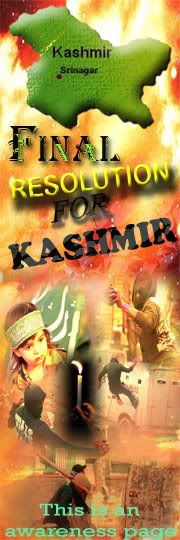
Final Resolution For Kashmir
Official Website
Kygrp Author Grid
-
My Way
Facebook Profile


-
Archives
- December 2012 (3)
- April 2011 (7)
- February 2011 (1)
- January 2011 (24)
- December 2010 (15)
-
Categories
-
RSS
Entries RSS
Comments RSS

